

Waste from cocoa cultivation yields a valuable product
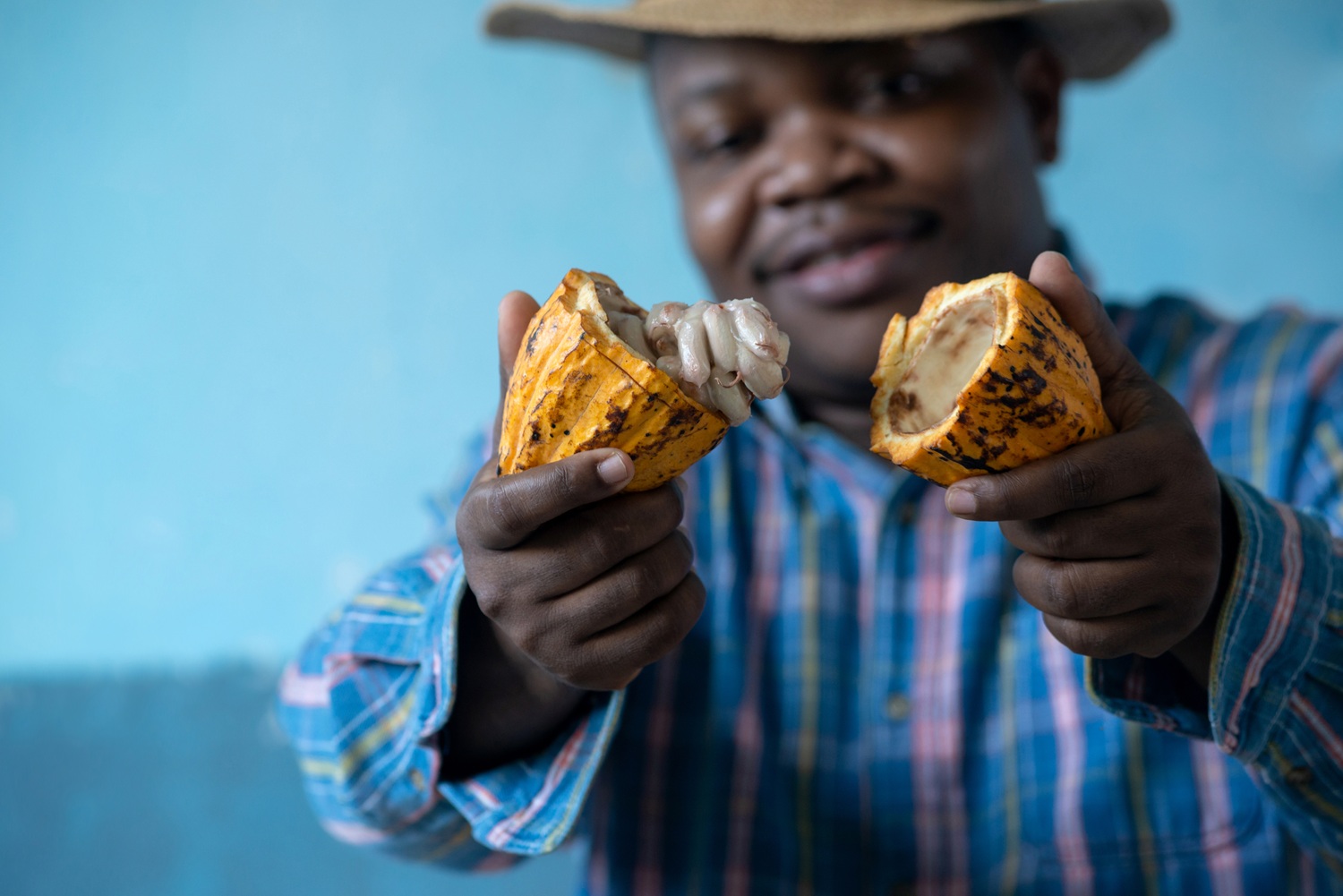
Most chocolate lovers are unaware that cocoa farming generates enormous amounts of organic waste. Only 10% of the cocoa fruit is used. Yet the remaining biomass still has considerable value, as demonstrated in a project by Partners for Innovation. 5 Questions to project leader Peter Karsch.
What was this project about?
The project aimed to improve the cocoa value chain in Côte d’Ivoire. It explored how farmers can increase their income not only by selling cocoa beans, but also by selling the husks: the empty cocoa pods. Every tonne of cocoa beans produces around 10 tonnes of empty pods. These husks can be used as a soil improver, generating extra income and reducing expenditure on chemical fertilisers.
At present, the empty pods are simply left on the fields, which has a very negative environmental impact. This organic waste emits methane as it decomposes. Earlier calculations showed that greenhouse gas emissions from cocoa farming in Côte d’Ivoire are comparable to one and a half times the annual CO₂ emissions of the Tata Steel factory in the Netherlands, the country’s largest emitter.
Removing these empty pods therefore delivers a significant environmental benefit, further enhanced when this residual stream is put to good use. In addition, it can increase the income for cocoa farmers: currently, only one in four farmers earns a living income from cocoa cultivation. Dutch research institution TNO has developed an advanced technology (‘Enerchar’) that converts these empty pods into biochar and clean energy.
What is biochar?
Biochar resembles charcoal. It stores CO₂ for the long term and improves soil fertility by helping the soil retain water. Compared to existing biochar production methods, the Enerchar technology has the major advantage of releasing hardly any greenhouse gases or harmful substances during the process, while simultaneously generating energy. This further reduces the overall climate impact.
Were the tests successful?
The tests were very successful. Samples of empty cocoa pods were shipped from Côte d’Ivoire to the Netherlands, where TNO converted them into biochar in a laboratory setting. This was done through pyrolysis – heating at a high temperature in a low-oxygen environment. The pods do not burn but gain the characteristic black, charcoal-like structure. The resulting biochar was of excellent quality, and harmful emissions were negligible.
But isn’t biochar already being produced in many countries?
That is correct. Various production techniques exist. You can produce it in a pit in the ground or with a simple boiler (the so-called kon-tiki kiln). However, TNO indicated early in the project that it is impossible to achieve a positive climate impact with such basic methods. The TNO process produces very high-quality biochar that stores carbon reliably for more than 100 years. As a result, it can be used to obtain carbon credits, which have economic value. This helps build a viable business case for the technology.
How can these higher incomes for cocoa farmers become a reality?
This project—carried out with TNO, LONO, ETG Beyond Beans and Imset, and financed through an RVO Small Business Innovation Research (SBIR) grant—has now been completed. The goal was to demonstrate that a strong business case is feasible and that high-quality biochar can indeed be produced from cocoa pods using the Enerchar process. Despite the relatively high moisture content of the biomass, this has been achieved. The project’s main question has therefore been answered.
Together with the same partners, we are now exploring the possibilities for a follow-up project to build a biochar production facility in Côte d’Ivoire. This would require substantial investment, so the next step is to identify potential funding sources. In parallel, we aim to secure demand for the produced biochar and the associated energy.
Want to
know more?
Contact us!